

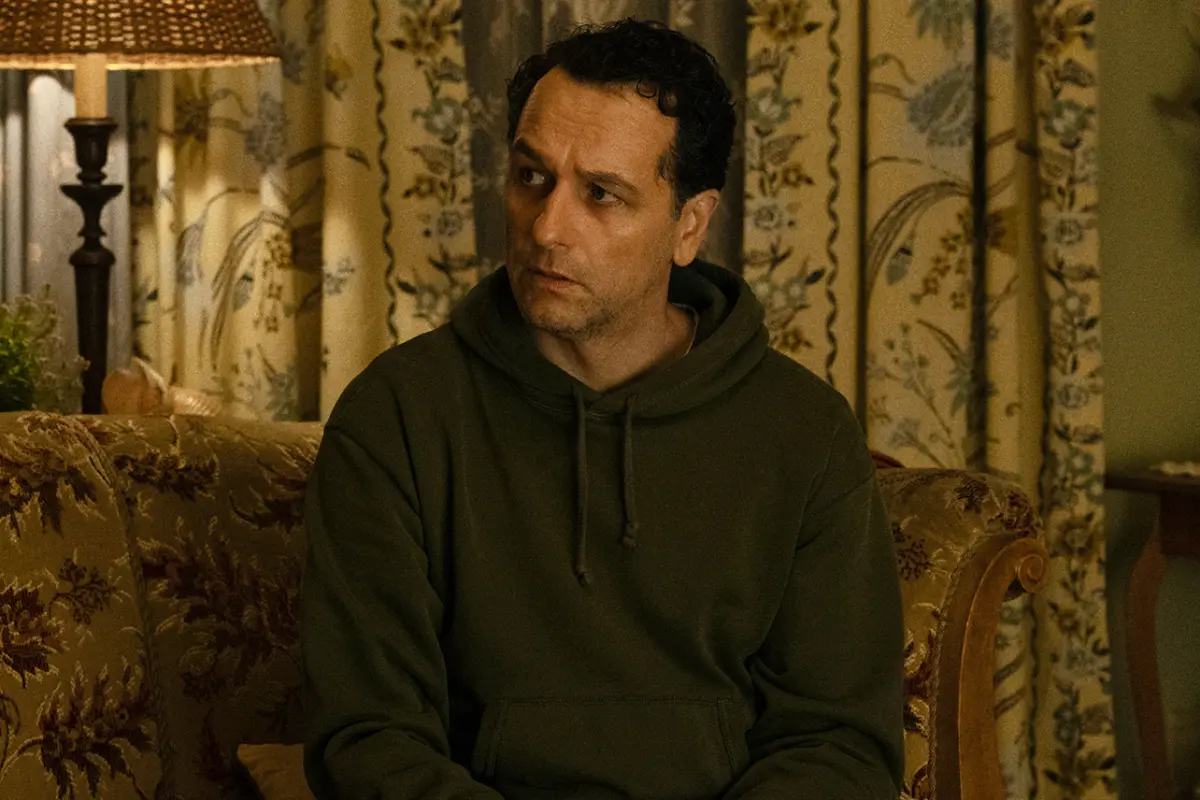
“The tradition of all dead generations weighs like a nightmare on the brains of the living.” In Widow’s Bay as in the real world, Karl Marx was right. In a sense, Widow’s Bay is a complex metaphor for trying to survive and stay sane in that nightmare world. Life is a horror show, driven by the failures of our dead forefathers, and the cost of putting an end to it may not be one we are willing or able to pay. By fighting it, we are forced — or we choose — to become monsters ourselves.
That’s the fancy-pants, mainland way of looking at this episode. The other way, the island way, is Holy shit, they did human sacrifices depending on the number of times the cursed church bell tolls, and now Loftis is trapped on the island forever because his son Evan is the final descendant of Richard Warren, and as long as he’s alive the sacrifices must continue???
All that and it’s funny, too? To borrow a term from Stephen King: That’s good TV, Dear Reader.
So yes, on one level, Widow’s Bay’s first season finale (hooray for the Season 2 renewal!) is grim business. Both Mayor Tom and Sheriff Bechir try to kill kindly, elderly Ruth Livingston in order to save the island, their loved ones, or some combination of the two. It’s the classic trolley problem, where you can do nothing and allow many people to die, or do something and personally condemn one specific person to death yourself instead.
When Tom discusses it with Ruth without specifying why, her response no doubt speaks for many viewers, too. “The runaway trolley is life — the lever’s me,” she explains. “You can’t control the bad things that happen in life, Tom! But if I pull that lever, it’s a choice, and I’m choosing to kill that person, and I could never do that.”
She then shows him a lengthy Tennessee Williams quote she’s cross-stitched: “We live in a perpetually burning building, and what we must save from it, all the time, is love.” The abyss gazes also, as Nietzsche said, and we must not allow it in. By that standard, Tom and Bechir fail. Only dumb luck prevents them from being murderers.
And for no reason, too! Doped up by Tom, Ruth reveals that she had a secret daughter with a married man, whom she gave to him and his wife to raise as their own. That, of course, was Lauren, Tom’s late wife, making his son Evan Richard Warren’s final descendant, as it long appeared he would be. I don’t mind the predictable outcome given the unpredicted twist it took the show to get there, and the outstanding work done by K Callan as Ruth as a result.
Yet the horrors cease even though both Ruth and Evan are still alive, because the evil in the island has claimed a different victim instead. While panic grips the shelter because food, water, and light are running low, Dale discovers a cache of old film canisters and fires them up.
That’s how he learns the horrifying truth about Widow’s Bay: When the church bell tolls, that number of souls must be sacrificed to the island entity. As recently as this 1960s-ish film was made, it appeared to be the town’s official policy.
He doesn’t take it well.
So yes, that’s the purpose of the torture chair and subterranean doors that Evan and his jackass friends find beneath the shelter — which is where poor Kenny the custodian (Michael Malvesti) is dragged off into oblivion while Evan tries in vain to rescue him from the other side of the door.
And just like that, the storm lifts, and the panic with it.
I went back and checked, and the church bell tolls nine times in the middle of the night at the start of Episode 2. Unless my count is off, nine souls have met their end this season: Shep the fisherman, the Sea Hag, Rev. Bryce, Richard Warren, an EMT and a gas station attendant killed by the Boogeyman, the Boogeyman, Todd the Shaman, and Kenny the custodian. It’s possible my count is off, and I’m not sure if, uh, entities fit the requirements laid out in the “So, you’re an Offering” filmstrip, but otherwise it looks like things line up nicely.
So it’s probably bad that as a peaceful Tom and Evan look out over the sunlit water after he tosses the Warren family’s heirloom brooch into the depths, the church bell rings eight times, huh?
Speaking only for my own preferences, I find sitcoms to be weak as a load-bearing structure. The whole project is often dragged down into sappiness when serious themes are broached, because the need to make the audience laugh undercuts the seriousness, even the pain, of those themes. It takes a show willing to really sit with that pain (Girls) or go in the complete opposite direction and offset the seriousness with absolute silliness (Scrubs) to make it work, and those kinds of balances are hard to strike.
Widow’s Bay makes it looks easy at an even higher difficulty setting. Creator Katie Dippold’s script for this episode alone layers black comedy (Dale’s horrified face after watching the filmstrips, the “HOW TO SUBDUE SOMEBODY” poster on the examining room wall), genuine scares (those eerie commands on the loudspeaker, the footage of human sacrifices in their underwear with bags over their heads), real human drama and ethical issues (the moral dilemma facing Tom and Bechir, the question of whether Ruth’s overwhelming goodness is mere naïveté or essential to remaining human), and the whole Karl Marx thing if you wanna read that deep into it, which I do. A lot of shows would simply collapse under all that weight.
But just as it has been from the start, Widow’s Bay is built to withstand that test. Dippold’s concept and writing, Hiro Murai’s directing, the perfect cast full of incredible actors creating instantly recognizable and indelible characters, the strength of the world-building as both a parody of Stephen King/H.P. Lovecraft cursed New England towns and as an exemplar of them…Widow’s Bay is well constructed in a way that leaves one reaching for comparisons like Mad Men or The Terror on one hand, Cheers or The Golden Girls on the other. I can’t wait until the next tourist season begins.
Sean T. Collins (@seantcollins.com on Bluesky and theseantcollins on Patreon) has written about television for The New York Times, Vulture, Rolling Stone, and elsewhere. He is the author of Pain Don’t Hurt: Meditations on Road House. He lives with his family on Long Island.