

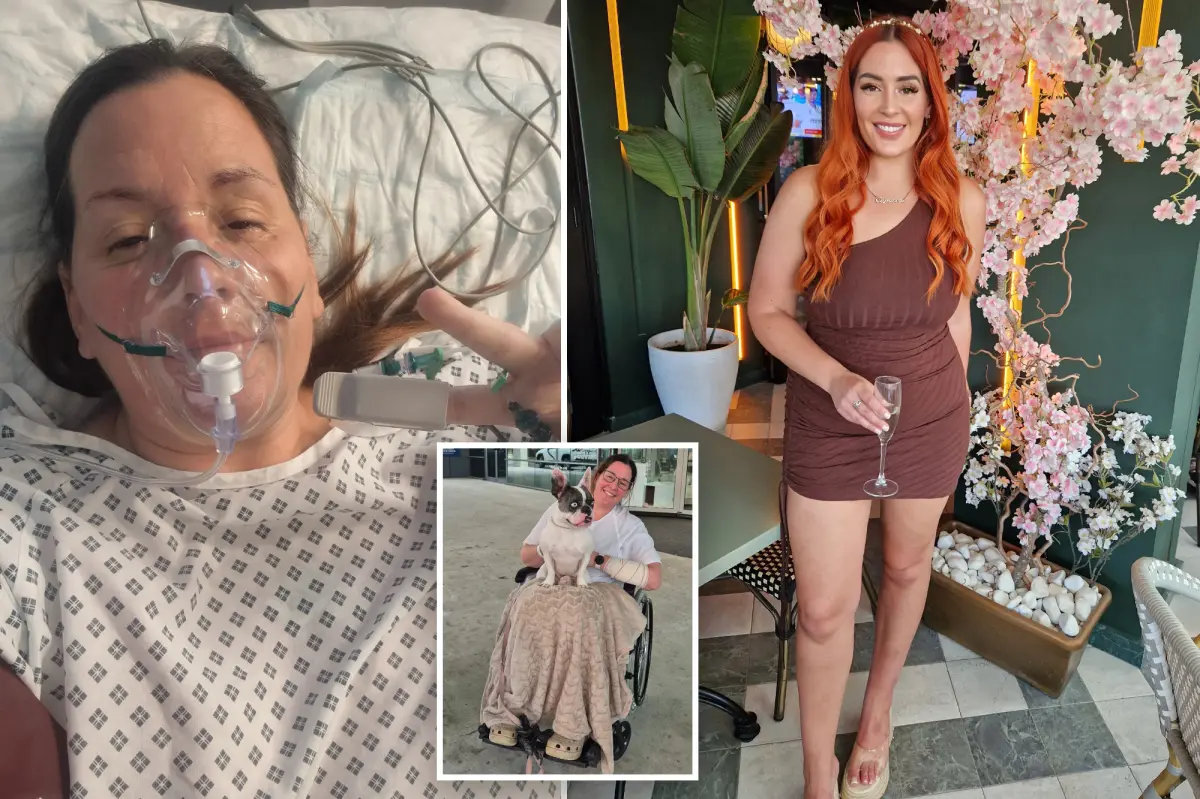

A woman who woke up with “gym” aches was struck down by a sudden paralysis, caused by a rare condition.
Charlie Wilson, 38, was living a “completely normal” life working in Magaluf, Mallorca, before she lost movement in both legs, her left arm, and neck.
She broke out in lumps all over her body, but doctors didn’t know what was causing her pain.
After multiple tests and scans and a three-week stay in hospital, Charlie was finally diagnosed with extrapulmonary sarcoidosis – a rare condition that causes small patches of swollen tissues to develop in the organs of the body.
In Charlie’s case, her condition is isolated and does not affect her lungs – the most common place for the condition to form – and instead affects her limbs, joints, and bones.
Now, her condition has forced her to move home to the UK, where she has moved into a bungalow with carers visiting four times daily.
Charlie says her movement has returned, but she now uses a wheelchair for flare-ups, which leave her in pain.
Charlie, a former shot girl and social media manager, from Darlington, County Durham, says: “My life was completely normal.
“I had literally just been for a walk on Palma Nova beach.
“The next day I woke up and everything was literally normal.
“I woke up the next day, and my body felt like it would if you go to the gym and get that ache, but I don’t go to the gym.
“It got to the point where I literally could not move, so my friend took me to the doctors so she could translate as she speaks Spanish.
“At that point, if I had the option to amputate my legs, I would have had it, that was the level of pain I was in.
“My sister flew over to look after me, and she had to carry me to the toilet.
“My friends kept calling the doctors on my behalf because I was in so much pain I couldn’t do a lot.
“They said, ‘We need a blood result immediately.’
“Finally, they called and said, ‘come in in the next 30 minutes’.
“She [the doctor] looked at me, took a pen and paper and said ‘you, hospital, urgently, now’.”
Charlie woke up in March 2025 to muscle pain that got progressively worse as the day went on.
Rushing to both her local doctors and then Son Espasas University Hospital, she was sent home with painkillers after blood tests came back clear.
But Charlie began to lose movement in her legs, and her twin sister, 38, flew to Spain to help look after her.
She needed a wheelchair to get around, 24-hour care, and had to be fed through a straw.
On April 2 2025, she had more blood tests, and results revealed her vitamin B12 was “dangerously low” as well as her folic acid, potassium, and iron levels.
Her inflammation markers were high also, and Charlie was admitted again to Son Espasas University Hospital as doctors said they “didn’t understand” what the cause of her pain was.
“The doctor said he doesn’t understand what’s going on,” she said.
“They brought out two neurologists to do a brain scan.
“I had 33 blood tests, a chest scan, a brain scan, a CT scan, and a PET scan.
“They found something in the biopsy, and they thought it was sarcoidosis, but that comes up in your lungs.
“There was nothing wrong in my torso.”
Charlie was eventually diagnosed with extrapulmonary sarcoidosis, with Charlie’s type that forms in her limbs and joints, affecting just 1.4% of people with the condition, and was placed on methotrexate, a low form of chemotherapy, once a week for two months.
After it “wasn’t working,” she was moved onto adalimumab, which she says blocks the part of the body that produces inflammation.
She also says the medication slows her immune system, meaning she is “constantly sick”.
Unable to return to work, she moved back to the UK in December 2025 and is still awaiting her medication to be prescribed, as it was in Spain.
She also has hidradenitis suppurativa (HS), which she also diagnosed with during her initial hospital stay after it lay dormant for years previously, which is a chronic, painful skin condition that causes recurrent lumps, abscesses, and tunnels under the skin, primarily in areas where the skin rubs together.
Her adalimumab medication has worsened the condition, and recently she was admitted for surgery to remove abscesses in her armpits.
“When I’m OK and out of a flare-up, I’m OK and can walk around Tesco’s, for example, but that would wipe me out,” she said.
“I was recently housebound for a few days and then bedbound.
“My life before I travelled the world and was used to going from country to country.
“Now I’m lucky if I go into four different rooms every day.
“I don’t really tend to go out so much – I’m in a wheelchair now when I’m in a flare up, and I can’t get up and down kerbs by myself, so it’s not very often I go out in my wheelchair.
“And the boredom is terrible, my sister and my friends have bought me colouring books, I can only watch so much TV.
“It’s a once-in-a-lifetime illness I’m dealing with.
“There’s hardly any medical literature on it.”