It’s time to break out your cowboy boots and bust a move!
Hallmark Channel‘s Texas Two-Step premieres tonight, bringing the network’s signature romance to the Lone Star State. Tonight’s new movie follows Olivia (Heather Hemmens), who returns home to Texas to help her aunt’s struggling country bar. While there, she is not only reminded of her love of dance, but also reunites with her former flame, Luke (Brendan Penny).
Summer is in full swing at Hallmark with its Summer Nights movie lineup, which began with last week’s The Greek Aisle. You can check out DECIDER’s The Greek Aisle cast guide and The Greek Aisle review here. There’s more where that came from, with two more movies premiering this month that are sure to satisfy your movie night needs.
If you’re planning on watching Texas Two-Step when it premieres tonight at 8/7 c on Hallmark Channel (with next-day streaming on Hallmark+), give DECIDER’s Texas Two-Step cast guide a read below.
Photo: Syd Wong/ Hallmark Media
Heather Hemmens plays Olivia, a Texas native who grew up with her aunt and has fond memories of the country bar she owns. Though Olivia is currently working as a producer for a high-profile photographer, she longs for more out of work, and to one day be the one behind the camera.
Hemmens is a Hallmark Channel fixture, most recently starring in 2025’s The Snow Must Go On alongside Corey Cott. Outside of the network, she is best known for her work on If Loving You is Wrong, Dad Stop Embarrassing Me!, and Roswell, New Mexico.
Photo: Eike Schroter/ Hallmark Media
Luke (played by Brendan Penny) is Olivia’s childhood sweetheart, who has stayed in the town of Blue Creek and is a certified cowboy. However, his feelings for Olivia may have never subsided after she left town.
Ruby (BJ Harrison) is Olivia’s aunt and the proud owner of Sweetwaters, the best country music bar in Blue Creek, Texas. Now running the business alone in the wake of her husband’s passing, Ruby is happy to have Olivia back home, though she doesn’t necessarily want all of her help.
June (played by Kaylah Zander) is Olivia’s best friend, who accompanies her to Texas to meet her famous Aunt Ruby. However, another one of Olivia’s relatives might just catch her eye.
Nathan Witte plays Mason, Olivia’s second cousin who is juggling a job as a vet, serving as Blue Creek’s mayor, and caring for his Aunt Ruby. However, he might just find time for love, too.
Bryan Boone (Zach Smadu) grew up with Olivia in Blue Creek, and has grown up quite a bit since he last saw her, and has become a very successful entrepreneur.
Newport Beach residents have been urged to protect themselves from dangerous high tides this weekend that are expected to flood streets and homes in the area.
Newport Beach issued an advisory Friday to prepare for the so-called “king tides” from Saturday through Tuesday.
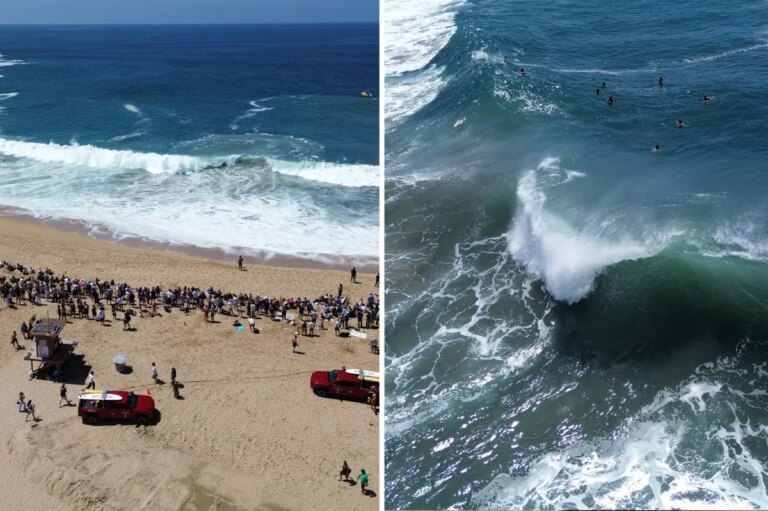
California residents have been warned to look out for dangerous high tides deemed “king tides” this weekend, which are projected to flood and soak neighborhoods in Orange County. Pedro Colo for CA PostOfficials have advised which areas will be impacted and what residents should do. Pedro Colo for CA Post
Flooding has already impacted Newport Beach, toppling a lifeguard tower and enveloping a construction vehicle that was abandoned on the beach. Another lifeguard tower was seen surrounded by water while tied to the flood walls.
Officials have advised which areas will be impacted and what residents should do.
“Areas most susceptible to flooding include Newport Island, Balboa Island, Finley Tract, Lido Village, Balboa Village, LaFayette Avenue, the Peninsula and portions of the Marcus River and Lake Avenue area,” according to a dispatch from the Newport Beach City Manager’s Office.
“Residents with properties adjacent to Newport Harbor should take precautions, including installing seawall plugs and placing sandbags in vulnerable areas,” the dispatch added.
Newport Beach officials are preparing for the rising tides with pumps and sandbags, among other precautions. Pedro Colo for CA Post
Newport Beach officials are preparing for the rising tides with pumps and sandbags, among other precautions.
“Our crews are prepared and will be working throughout the weekend to monitor conditions and respond to localized flooding caused by the king tides,” Mark Vukojevic, utilities director for the city, told the Orange County Register.
Sign up for the California Morning Report newsletter
California’s top news, sports and entertainment delivered to your inbox every day.
Thanks for signing up!
“We have deployed pumps in historically affected areas and taken proactive measures to help protect neighborhoods and keep roadways accessible, including installing gap boards on Balboa Island and placing sandbags in vulnerable areas.
“We have also been in contact with property owners in areas that typically experience ponding or have lower seawalls, encouraging them to take additional precautions to help protect their homes and property,” he added.
“Residents with properties adjacent to Newport Harbor should take precautions, including installing seawall plugs and placing sandbags in vulnerable areas,” the dispatch added. CBS LA
The flooding comes as a 5-year-old girl, Amada Mia Brown, was swept away by a massive wave in Laguna Beach on Tuesday. Her body was found Thursday after a desperate search. Her mother and another child survived after bystanders intervened to rescue them.
Laguna Beach Mayor Mark Orgill called it “one of the most heartbreaking incidents I have witnessed during my time serving this community.”
“Our hearts go out to the young victim’s family, friends, and all those affected by this tragic loss. On behalf of the Laguna Beach community, I extend our deepest condolences and want the family to know they are in our thoughts and prayers during this unimaginably difficult time,” he said.
Download The California Post App, follow us on social, and subscribe to our newsletters
Back in the ’60s my friend’s mother gave birth to a child with Down Syndrome. The doctor immediately told her that he’d “take care of the baby.” She declined. That baby, Grace, recently turned 60. She’s been gainfully employed by a non-profit organization and is loved by hundreds. Imperfect? Maybe. But perhaps more perfect than the rest of us.
Scott Ventrella
Ridgefield, Conn.
Pope Leo, lefty
It seems as if Pope Leo is far more interested in advocating for far-left causes, such as welcoming illegal immigrants and obsessing about climate change, than proclaiming the salvation through Jesus Christ (“Pope Leo’s Dubious Migrant Misstep,” Daniel McCarthy, PostOpinion, June 9).
I think that the Chicago native would have been more comfortable staying at home and running for mayor or governor on a far-left platform than pretending to be the Vicar of Christ.
Dennis Ricupero
Port Chester
Troubled teens
Karmelo Anthony was found guilty of murdering a fellow teen and sadly, stories like this are reported all across the country (“Karmelo guilty in teen slay,” June 10).
Reporters should investigate how these youth are raised. People are born and then created by their environment. The more we investigate how these individuals are created, the more interest there will be in making change in the environments that created them.
Harry Winkler
West Palm Beach, Fla.
DSA’s dangers
Stu Smith’s column on the Democratic Socialists of America was informative and frightening (“Down a radical ‘rabbit’ hole,” June 10).
To think America has a completely subversive group openly operating to destroy us from within is very troubling. The DSA is slowly becoming an accepted political party. We are electing people without understanding the sinister motives they are harboring and the un-American ideas they speak.
Kenneth Lebeck
Plainview
Retire the horses
The death of yet another New York City carriage horse serves as a tragic reminder that the time has come to retire these majestic animals from our city streets (“Carriage horse dies in Cent. Pk.,” June 10).
There was a time when many people couldn’t imagine a world without elephants in circuses. Yet the removal of elephants from the Ringling circus eventually occurred — and most would agree it was long overdue. The same principle applies today to New York City’s carriage-horse industry.
It’s time to retire these horses with dignity and help carriage drivers and owners transition to more humane and sustainable ways of making a living.
John Hynes
Get opinions and commentary from our columnists
Subscribe to our daily Post Opinion newsletter!
Thanks for signing up!
Gilbert, Ariz.
NFL nonsense
There are many things going on in this country that deserve our representatives’ attention — the NFL should be at the back of the line (“Blitzing screen,” Business, June 11).
When we voted for change, we did not mean the channel. The DC swamp is getting deeper. Fraud, inflation, crime, war and illegal immigration should be Congress’ main concern. Not wasting the people’s money on the NFL’s streaming revenues, something the Federal Communications Commission should handle.
Philip Vallone
Ossining
Want to weigh in on today’s stories? Send your thoughts (along with your full name and city of residence) to letters@nypost.com. Letters are subject to editing for clarity, length, accuracy, and style.
If I were to tell you there once existed a “genius sperm bank” which exclusively accepted the semen of Nobel Prize winners, you’d be forgiven for thinking it was a dystopian sci-fi plot.
Yet exist it did.
It was one of the most radical experiments in human breeding and genetic engineering the world has ever known.
It had a big yet inadvertent impact on shaping the fertility industry as we know it today – including in Australia.
What’s more, the so-called genius offspring – 217 of them – are coming of age today and could help settle an age-old question: are such traits down to nature or nurture?
One author of a newly released book, having studied such super kids, has a somewhat blunt answer.
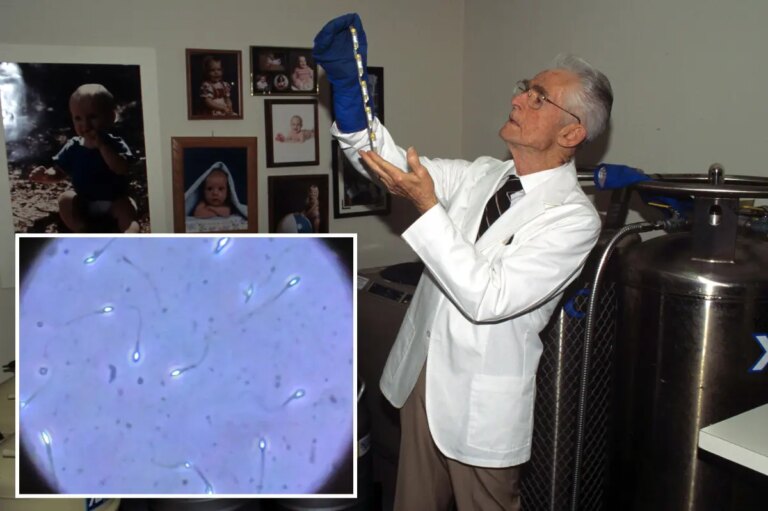
Dr. Robert Klark Graham of the Nobel Sperm Bank is pictured inspecting specimens. Peter Brooker/Shutterstock
Nobel laureate sperm only
Created in the 1970s, the infamous sperm bank was accepting donations for its controversial elitist experiment in the USA right up until 1999.
That means the youngest of its new breed of so-called geniuses will be turning 25 around now.
Conceived by American millionaire Robert K. Graham, who made his fortune by inventing scratchproof lenses for spectacles, the idea was to collect sperm from Nobel laureates in science and distribute it to “intelligent women.”
Spermatozoa are seen through a microscope at the Center for the Study and Conservation of Human Eggs and Sperm at the university hospital (CHU) of Rennes, western France, on March 12, 2024. AFP via Getty Images
The ultimate goal? To breed an entire generation of geniuses. Its official name was “Graham’s Repository for Germinal Choice.”
Graham wanted to do this because he believed the American population was getting lazy and degenerate. He was alive at a time when American paranoia about communism being the very opposite of the American rugged individual dream was soaring.
In a welfare state, “retrograde humans,” as Graham called them, could flourish. He couldn’t have that – and his social engineering endeavour would counter it.
Ultimately, Graham recruited just three Nobel laureates to his cause.
In announcing the plan, he understandably became a pariah and was roundly ridiculed and condemned in the American media – from newspaper columns to “Saturday Night Live.”
What he was proposing was uncomfortably similar to the eugenics espoused by Adolf Hitler himself.
Nobel Prize-winning American physicists (L-R) John Bardeen, William Shockley and Walter Brattain, who invented transistors, conduct an experiment, circa 1955. Getty Images
Yet he was surprised by the outrage and comparisons to Nazi ideology of creating a “master race.”
He played down accusations of racism and eugenics, claiming “a few more creative intelligent people might be born.” And indeed they were.
But things would get worse – and even crazier – than anyone could have imagined once the donors started coming forward, and supposedly super smart babies began being born.
The genius myth
The first pitfall happened quickly. Spooked by the bad press, two of the Nobelists – fearing their identities would be revealed and reputations ruined – backed out and never donated again. That left the Nobel sperm bank with just one Nobel laureate.
And he was among the worst Nobel laureates in history.
On paper, William Shockley looked like the perfect sperm donor to people who subscribed to such ideas. He’d won the Nobel prize for inventing the transistor, and opened the first ever company in Silicon Valley.
Nazi stormtroopers in Weimar, carrying swastika flags in ceremonial dress, in 1936. Getty Images
“The genius myth is the idea that there are a set of stories that we tell ourselves about high achievement, and they’re not always true,” Lewin tells news.com.au.
“The question is, how is ‘genius’ bestowed – with what criteria? It’s often what people in a particular culture value at that time – and that then changes over time.”
In the book, she questions the very idea of geniuses, showing how they often reveal our need for a hero and a narrative (often a greatly exaggerated ‘founder’s story’).
These raise the genius to a celebrity cult status, often overlooking the ‘villages’ (teams of people) and societal structures (class, gender, race) that enabled them to become thus elevated. She warns of the “dangerous allure” of “rebels, monsters and rule breakers.”
Start your day with all you need to know
Morning Report delivers the latest news, videos, photos and more.
Thanks for signing up!
Shockley is the perfect personification of this. He consistently claimed that black people were less intelligent than white people – and was widely despised for such racism. He proposed sterilizing people with low IQs.
He even claimed, without any sense of irony, that his own children were disappointingly inferior in intelligence (not one of his three children attended his funeral).
He blamed his wife, whom he claimed they took after. Presumably he believed his genius sperm bank donation would suffer no such deterioration owing to pollution by less intelligent breeding recipients.
Yet he was very wrong there, too. Shockley was 70 when he donated in 1977. He traveled to a Travelodge, met Graham, produced his sample, and the two men parted ways.
For a self-made millionaire innovator and Nobel prize-winning scientist, what happened next simply added to the widespread lampoonery.
First, Graham attempted to sneak Shockley’s pensioner sperm onto a plane. He didn’t want to put it through an X-ray machine, because radiation can cause abnormalities.
But he was foiled by air stewards who saw liquid nitrogen curling out of the container – and was kicked off the flight. He somehow persuaded a pilot to let him fly with the semen sample in the cabin the next day.
Then there was the fact Shockley’s donation didn’t produce a single child. Scientist Shockley was shocked. He later told Playboy in an interview that he had no idea men’s sperm deteriorated in potency with age.
Graham, whose estate was picketed by demonstrators, even hired guards to protect his precious vats of frozen sperm. But given two Nobelists had dropped out, and Shockley’s aged semen was practically useless, the security were in effect guarding literal blanks more than a sperm bank.
As such, not one child of a Nobel Prize winner was ever born from the Nobel Prize sperm bank.
The closest it came was the unemployed son of a Nobel laureate who, upon donating, was quoted as saying: “I’m helping the human race because I have good genes. I have studied evolutionary biology and this is what evolution is all about. Winning is passing on your genes and losing is failing to do so.”
He had no kids with his own wife.
Roundly mocked, borderline fascist, no fecund laureates, ancient degraded semen that could barely breaststroke across a puddle and championed by narcissistic men half as intelligent as they claim, including a scientist with little understanding of basic science – the genius sperm bank looked doomed to fail.
Yet within a few years, it was receiving more requests for sperm than it could handle.
Criminals
In 1985, the genius sperm bank downgraded its entry requirements to sports stars and self-made millionaires. As such, it became the high achievers sperm bank, increasing both the donor pool, and demand.
Rough seas still plagued this rebranded version, though.
In the early 1980s, one couple who’d had a daughter via the sperm bank told journalists they planned to raise a “female Thomas Edison or Einstein.”
It later emerged that the couple had lied to get access to such elite sperm. They’d actually just been released from prison – they’d been using the identities of dead children to obtain loans, and the mother had lost custody of children from her first marriage after punishing them for poor academic performance.
What has happened to the genius children?
So what of the kids described as test tube superbabies?
In his 2005 book “The Genius Factory,” journalist David Plotz tracks down some of them and ponders what they can teach us about the nature versus nurture question of high achievement and intelligence.
Some are, undoubtedly, geniuses.
One – Doron Blake – was reading “Hamlet” at six, writing a book at 11 and scoring 180 on early IQ tests. He later studied at Harvard.
With the other children born from the sperm of high achievers, there are stories of straight A students, leads in school plays, musical instrument playing proficiency, mathematical wizardry and sporting prowess.
Dr. Afton Blake is pictured with her son, Doron, the first test tube baby from the sperm of a genius sperm bank on Feb. 3, 1986, in the San Fernando Valley, Los Angeles, California. Getty Images
But, significantly, there are also other, less sensational stories. They aren’t all geniuses. They aren’t even all high achievers.
They’re “spread in a bell curve, slid a bit to the right of average,” Plotz writes.
“Some are brilliant. Most are very good students. And some are quite mediocre. Three of the 30 I know have severe health problems.”
When it comes to nature versus nurture, there’s actually little they can tell us – Plotz’s sample was small, and self-selecting. And the women who seek out a Nobel prize sperm bank, he writes, “become the over-involved mums who push their children into piano lessons at 3 and Ancient Greek at 5.”
As such, it’s “impossible to determine if their children’s talents are the result of nature or nurture, because they’re getting double helpings of both.”
What Doran can tell us
Doron Blake’s mother was one such eccentric character. She doted on him, breastfeeding him until he was six. She did past life regression with her psychology patients. She later charged reporters for interviews with her genius son.
And his story can perhaps tell us the most. He was bullied at school for being a donor baby.
For all his achievements, his first and foremost listed accomplishment on his Facebook page – above his Harvard attendance or teaching Buddhist philosophy, is “house dad”.
His Facebook picture features him, bespectacled, hugging his partner and two children.
“It was a screwed-up idea making genius people,” he told Plotz.
“It’s foolish to judge anyone by his intelligence. The fact I have a huge IQ doesn’t make me a person who is good or happy – I don’t think you can breed for good people.”
Impact on today’s fertility industry
Despite the setbacks, mockery and its ultimately failed mission, the controversial sperm bank had an inadvertent impact on today’s fertility industry.
Donors in Australia today are routinely asked their highest academic achievement, about their career, their full medical history and how often they exercise. Donors with university degrees get chosen before those without them.
Plotz says that Graham’s “unabashedly elitist” sperm bank “democratized fertility” by “upending the hierarchy, shifting the power away from the tyranny of “dictatorial” early fertility doctors and onto consumers, giving them choice.
It was an accidental impact of a doomed venture. Prior to his sperm bank experiment, donor insemination involved doctors inseminating women with unknown sperm and encouraging couples to lie and pretend the baby was theirs.
What Graham understood as a businessman was how to prioritize the needs of his customers. And his customers weren’t all as elitist or eccentric as it first seems.
Despite the setbacks, mockery and its ultimately failed mission, the controversial sperm bank had an inadvertent impact on today’s fertility industry. koya979 – stock.adobe.com
His was one of the world’s first sperm banks to put their prospective donors through medical tests and provide the donors’ medical history. Many of the women – a sizeable cohort of whom worked in the health industry – sought sperm from it because they prized this health information over intellectual quotient.
But how far can the bar lift when it comes to consumer choice? In Iceland, almost all diagnosed Down syndrome pregnancies are aborted after prenatal testing. Other countries aren’t far behind.
“All sperm banks have become eugenic sperm banks,” Plotz rather chillingly says of the infamous sperm bank’s legacy.
Yet it’s the donor-conceived children we should be listening closest to – and not just regarding the measurable number of their IQ, but something no donor screening or prenatal screening can ever fully measure or test for.
And that’s something Harvard graduate, 180-IQ, precocious Shakespeare-reading, genius sperm bank baby Doron Blake best surmised when he was tracked down.
It speaks to the reason why he prioritises the accomplishment of being dad to the two clearly cherished children in his Facebook profile picture above all others.
“It’s what’s in your heart, not your brain, that matters,” he said.
SAN JUAN, Puerto Rico — Armed men in Haiti have kidnapped James Boyard, cabinet director of the Defense Ministry and a highly respected security expert who also serves as inspector general of Haiti’s police, a person with the knowledge of the situation said Saturday.
He is the highest-ranking official to be kidnapped in the gang-wracked Caribbean country in recent years.
A person with knowledge of the situation who was not authorized to speak publicly about the case confirmed the kidnapping to The Associated Press on Saturday.
Local media reported that Boyard was seized Thursday in Bourdon, one of the few areas in Port-au-Prince that is considered relatively safe. An estimated 70% of the capital is controlled by a powerful gang coalition known as Viv Ansanm, which the U.S. designated as a foreign terrorist organization in May last year.
Boyard, who is also a political scientist, was tasked with helping rebuild Haiti’s armed forces and has helped assess Haiti’s National Police to implement reforms.
It was not clear who kidnapped him or whether a ransom has been requested.
“A person of this rank clearly has a fairly important security detail,” said Diego Da Rin, an analyst with the International Crisis Group.
He said the abduction of Boyard possibly suggests the kidnapping was planned with great detail and might have depended on the collaboration of someone close to his security detail.
Da Rin said kidnappings are increasingly occurring in areas of Port-au-Prince once considered safe, with gang members sometimes donning police uniforms and stopping drivers as part of fake operations.
He noted that gangs have been kidnapping people with double nationalities and targeting public officials. That could mean they are seeking higher ransoms and possibly trying to dissuade authorities from attacking certain gang-controlled territories where kidnapping victims are being held, Da Rin said.
Police recently have attacked Village de Dieu, which is controlled by the 5 Segond gang, led by Johnson Andre. Best known as “Izo,” he is considered one of Haiti’s most powerful gang leaders.
Da Rin noted that gangs have been taking some kidnapping victims to Village de Dieu.
High-profile kidnappings in recent years have targeted people including Haitian journalists and international missionaries. At least 267 people were reported kidnapped from December 2025 to February 2026, most of them men, according to a U.N. report. In 2025, 1,268 kidnappings were reported, a nearly 40% drop from the 2,058 kidnapping reported the previous year, the report stated.
ABUJA, Nigeria — Gunmen killed at least 17 farmers and wounded at least 13 others as they worked in their fields in northwestern Nigeria, a local official and a resident said.
The attack occurred on Friday in the town of Goron Namaye in the Maradun area of Zamfara state. No group has claimed responsibility but attacks by armed gangs have increased in recent months.
“The farmers were working on their lands when the bandits suddenly attacked and killed 17 of them,” Shehu Musa, a resident of Maradun, told The Associated Press on Saturday, adding that the wounded were being treated at a hospital.
The attack was a result of the refusal of the Zamfara state government to negotiate with the gunmen, Sanusi Dosara, chairman of the Maradun local government, said in a statement. Dosara appealed on government forces to dismantle the Bayan-Ruwa enclave in the Maradun forest, where the gunmen were hiding.
On Thursday, gunmen abducted 39 people in Magamin Diddi, a community in Maradun, while residents were meeting with the parents of a suspected bandit leader in an effort to negotiate peace and address kidnappings.
An insurgency in northeastern Nigeria, coupled with ransom kidnappings, has killed thousands of people and displaced millions over the years, according to the United Nations, despite repeated promises by President Bola Tinubu to curb the crisis.
A new survey has revealed the US cities with the worst pollution, including metrics for air quality and waste management, as well as how it affects both the physical and mental well-being of their residents.
The study, conducted by landscape care company LawnStarter, assessed more than 300 of America’s biggest cities using data from government agencies, including the Environmental Protection Agency, the Centers for Disease Control and Prevention, the US Census Bureau and County Health Rankings.
Newark, NJ ranked as the 6th dirtiest city in the US according to a LawnStarter study. Rob Thomas – stock.adobe.com
Their findings were weighted and grouped into four categories: pollution, inadequate living conditions, inadequate waste infrastructure, and resident dissatisfaction.
Every city was given a score out of 100, with the highest scores indicating the filthiest destinations.
While New York City managed to skirt the top 10, the Big Apple’s unofficial 6th borough, Newark, NJ, was outed as the 6th most unsanitary city, with an overall score of 48.06.
But it’s Newark’s resident dissatisfaction rate where they really shone, ranking 3rd out of 303 cities in total.
Meanwhile, two California cities, San Bernardino and Los Angeles, took the top two spots, respectively, along with Ontario, which sits about halfway between the aforementioned metropolises, at no. 5.
San Bernardino, California has ranked no. 1 in LawnStarter’s survey for two years in a row. Unwind – stock.adobe.com
This marked the former’s second year at no.1, thanks to their poor air quality — tying yet another Cali city, Ontario, for the worst in that category — as well as egregiously littered roadways, prevalence of junk yards (12 in all), and a 75% share of residents who say they’re dissatisfied with the city’s level of pollution.
Overall, a total of nine Golden State cities tied for the worst median air quality out of 100, one of the strongest showings by state on the list.
Detroit came in at no. 3, owing to the Motor City’s large population of smokers at nearly 24%, high toxic chemical waste management activity and inadequate living conditions.
Nearly a quarter of Detroit, Michigan residents smoke cigarettes — the leftovers of which often end up on the ground. f11photo – stock.adobe.com
Rounding out the top 5 leaves Reading, Pennsylvania, at no. 4, where they boast 18.42 metric tons of greenhouse gas emissions per capita.
10 most dirty US cities
San Bernardino, California
Los Angeles, California
Detroit, Michigan
Reading, Pennsylvania
Ontario, California
Newark, New Jersey
Phoenix, Arizona
Jersey City, New Jersey
Las Vegas, Nevada
Corona, California
10 least dirty US cities
South Bend, Indiana
Wilmington, North Carolina
Des Moines, Iowa
Davenport, Iowa
Athens, Georgia
Winston-Salem, North Carolina
Fargo, North Dakota
Frederick, Maryland
Pleasanton, California
Lynchburg, Virginia
While measures such as air and water quality remain much out of residents’ hands, there’s one dirty deed for which they can claim responsibility: littering.
The 2026 Keep America Beautiful National Litter Study estimates that 35 billion pieces of garbage are found outside of trash cans, with cigarette butts making up the largest share of inorganic material found dumped in streets, parks and shores.
Americans throw away an estimated 500,000 vaping devices every day. Ina – stock.adobe.com
Meanwhile, vape litter is skyrocketing, according to the US Public Interest Research Group, with one of the smoking devices discarded every 5.7 seconds.
That’s approximately 500,000 per day.
“Vapes have quietly become one of the most commonly thrown-away items in the country, and most people have no idea how harmful they are once they’re tossed,” said Shane Margereson, a spokesperson for vape retailer Ecigone.
Their toxic and hazardous components — such as lithium battery, plastic, metals and leftover nicotine — make tossing more complicated than most realize, as only 8% of users take the proper steps to dispose of vaping devices.
“Dropping one on the street isn’t just an eyesore; it leaks toxins into the soil and water as it breaks down,” Margereson continued.
“The single biggest mistake is putting a vape in your household trash or your home recycling, and it’s exactly what the Environmental Protection Agency tells you not to do,” Margereson said. “That lithium battery can be crushed in a garbage truck or compactor and start a fire, and it happens at waste facilities far more often than people realize.”
Instead of a standard garbage bin, vaping devices should be collected and brought to a hazardous waste drop-off point or collection event. And, despite their plastic parts, they’re absolutely not recyclable.
Meghan Markle’s As Ever brand could be facing a $5 million jam if the royal doesn’t find a way to offload her stocked items before they go out of date, a new report claims.
The Duchess of Sussex, 44, is looking at a deadline of next summer’s end to move all of her jams, teas and flower sprinkles jars before they’re no longer sellable, per Daily Mail.
With the loss of the jams alone, Markle could be facing a $5 million profit loss. The flower sprinkle jars could push that number even higher by another million.
Meghan Markle (pictured above arranging flowers in a basket) could be facing a $5 million loss with her As Ever brand. Meghan/ InstagramThe problem could hit the royal (seen here in an episode of “With Love, Meghan”) as early as next summer if she doesn’t offload all of her brand’s remaining jams, teas and flower sprinkles. JAKE ROSENBERG/NETFLIX
The “With Love, Meghan” host’s overstock issue dates back to another risky decision she made last year when she chose to rapidly expand her business shortly after seeing some success with her As Ever launch.
When the celebrity rolled out the lifestyle brand in April 2025, she quickly sold out of her assortments of jams, teas, crepe and cookie mixes and flower sprinkles in minutes.
She quickly followed it up with a restock two months later after having ordered “10x” her original amounts to account for popular demand. The move was yet another win for the entrepreneur as patrons bought all of her products almost instantly.
The next week, she added a rosé wine to the site’s offerings, and even that item sold out in under an hour.
All of her store’s products are expected to simultaneously go out of date by the end of next summer. (Seen here is Markle walking in Paris in October 2025). Getty Images for BalenciagaThe problem comes after Markle (pictured above in an episode of “With Love, Meghan”) decided to rapidly expand her business shortly after its April 2025 launch. JAKE ROSENBERG/NETFLIX
Want more celebrity and pop culture news?
Start your day with Page Six Daily.
Thanks for signing up!
In response to the bustling numbers in sales, Markle made the decision to take a huge leap in expanding her business.
“Suddenly the conversation goes from, at the start of this year, talking about a few thousand jars and lids, to we need to do a purchase order of a million. That’s a huge jump in just a few months of starting a business,” she told Bloomberg last August.
In January, a website glitch revealed she had around 650,190 units of unsold stock at that time. As we previously reported, sources told Page Six the royal had so much excess jam that she was just “giving it away” to Netflix staffers.
After seeing quick success with her first few launches, Markle decided to restock with “a purchase order of a million.” (Pictured here is a jar of Markle’s As Ever Strawberry spread). In January, a website glitch revealed that she had 650,190 units of unsold stock at the time. Meghan/ Instagram
However, Markle is now facing a new issue that threatens her chances of being able to sell off her inventory: the royal is now facing lower visitor numbers to her site.
According to Newsweek, the Duchess’ business is facing a slump which coincides with her lowered US popularity.
Data measured by Similarweb showed that the brand received 246,000 total visits to its site for the month of December — 180,000 of which came from the US alone. That number of US visits took a quick dive in January, reaching only 89,000.
Markle (seen here holding a jar of jam) is also facing other problems as her site’s visitor traffic has taken a nose dive, correlating with her lower US popularity. Meghan/ InstagramData showed the visitor traffic numbers fell from 246,000 in December to 178,000 in April. Meghan/ Instagram
The number of total visits continued to follow that trend of lower consumer tracking, with the site bringing in 213,000 (83,500 US) visits in February. It recovered slightly in March with 226,000 (94,000 US) visits, but fell once again in April with 178,000 (61,500 US) visits.
While the numbers are meant to be an indicator of how well Markle’s business is doing, it’s important to note that official figures have not been released.
A rep for Markle did not immediately respond to Page Six’s request for comment.