
Imagine a bustling Calcutta street corner in the 1920s. The air is thick with humidity and the fervour of political resistance. A young nationalist volunteer urges passers-by to boycott British goods in the name of the Swadeshi movement. Reaching into his pocket to light a lantern, he pulls out a matchbox bearing the image of Bharat Mata, or a charkha, or even Mahatma Gandhi. It looks unmistakably Indian. It feels patriotic. Yet there is a profound irony concealed within that box of safety matches. It was likely neither made by an Indian cottage industry nor manufactured in Britain. Instead, it came from a corporate giant headquartered in the small Swedish town of Jönköping, carrying the iconography of Indian nationalism through circuits of foreign trade and industrial manufacture.

That irony is where this story begins.
Matches were humble objects, used for cooking, smoking, worship, and domestic labour. But precisely because they were cheap, ubiquitous, and constantly handled, they offer an unusual entry point into the political economy of everyday life. A matchbox passed through bazaars, factories, dockyards, and households. It also crossed imperial frontiers. To follow the journey of a matchstick, therefore, is to uncover a much larger history of capital, technology, visual culture, and nationalism.
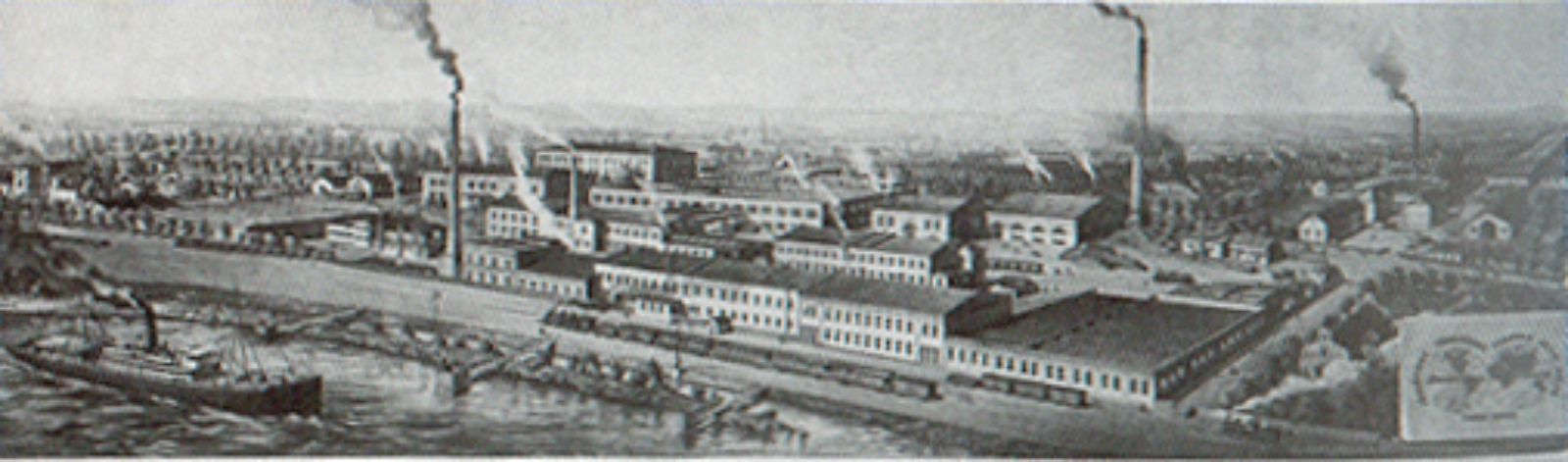 Jönköping Matchstick Factory, 1910. (Wikimedia Commons)
Beyond the imperial binary
For decades, the history of colonial India’s economy has largely been told as a binary struggle: the exploitative British coloniser on one side and the subjugated Indian subject on the other. That framework remains indispensable, but it is incomplete. It overlooks the “third men” — the ‘tertium quid’ of the colonial economy. Research on British managing agencies, Indian industrial capital, and foreign commercial houses has shown that late colonial India was shaped not only by the relationship between Britain and India but also by competition among British firms, Indian entrepreneurs, and other foreign actors who operated in colonial markets without directly ruling them.
This is where the Swedish Match Company, or Svenska Tändsticks Aktiebolaget (STAB), assumes historical significance.
In the National Archives of Sweden and scattered across repositories in Mumbai, Kolkata, Chennai, and Tokyo are company records, tariff inquiries, and trade statistics that tell the story of a Swedish firm becoming deeply embedded in India’s commercial life. Recent work on colonialism from the margins argues that states without large formal empires could still participate in imperial extraction and informal empire-building. Studies of Sweden’s overseas commercial expansion have similarly challenged the long-held assumption that Nordic enterprise existed outside colonial entanglements.
Tariffs, offshoring, and WIMCO
In the early twentieth century, STAB was not merely a company. It was a global empire built in Sweden under the leadership of the ‘Match King’ Ivar Kreuger. Founded in 1917, the company expanded rapidly through acquisitions, cartels and monopoly agreements. By 1930, it was the dominant owner of match companies in 33 countries and controlled about 60 per cent of the world’s match production.
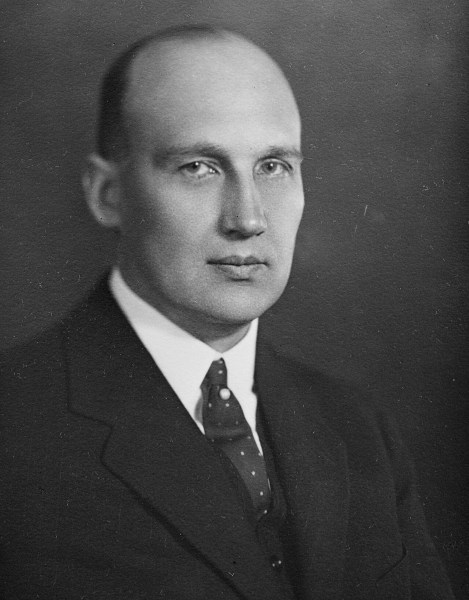 ‘Match King’ Ivar Kreuger (Wikimedia Commons)
India mattered enormously to this expansion. Research on the Japanese match industry suggests that before the First World War, Swedish and Japanese manufacturers often operated in distinct markets. India, however, was the principal market in which they competed directly. In 1910, the country had only six match factories, and domestic manufacturers were widely seen as undercapitalised and technologically weak. During the First World War, Japanese exporters captured a substantial share of this trade, while local industry remained fragile and unevenly developed. The Swedish answer was not retreat, but adaptation.
When tariff policy and protectionist pressure made exports less secure, STAB moved towards production in India (Håkan Lindgren, 1979; Hand Modig, 1979).
In 1923, the Western India Match Company, better known as WIMCO, was established in Ambernath near Bombay. Soon thereafter, WIMCO established a wider industrial network that connected Ambernath with factories in Calcutta, Madras and Bareilly in the United Provinces, Port Blair, and, through the Assam Match Company (AMCO), Dhubri, Assam.
Calcutta occupied a particularly important place within this network. The Alambazar factory, established in 1930, placed Swedish Match within one of colonial India’s most politically charged and commercially connected urban regions, where labour organisation, nationalist consumption, port trade, and industrial production intersected. During the 1920s, Swedish Match’s share of the Indian market rose from around 24 per cent to about 45 per cent. By 1927, its production in India was already as large as its exports from Sweden.
 The WIMCO factory in Ambernath (Niladri Chatterjee, Jönköpings Matchstick Factory Museum, Sweden)
Local production, however, required more than just capital. Swedish Match Company built an elaborate sales network through Indian canvassers who travelled districts, cultivated retailers, channelled orders to wholesalers, and reported market conditions to the firm. By 1932, the company employed around 60 canvassers in India and Burma (now Myanmar), all of them Indians. Its success, therefore, rested not only on European finance and machinery but also on Indian intermediaries who made local markets profitable for them.
The tariff debates of the late 1920s reveal the limits of both colonial policy and corporate strategy. Indian authorities were asking whether the country could sustain a protected domestic match industry, and one central issue was timber. Swedish Match argued on the technical and economic advantages of imported aspen. The Tariff Board, in contrast, maintained that the country’s labour force and market size could the domestic industry, even if raw material supplies remained imperfect in the short term. What emerges here is not a simple story of foreign domination or Indian weakness, but a contested industrial landscape in which technology, environment, taxation, and market size all mattered at once.
Labour, welfare, and conflict
The localisation extended to the factory floor. Swedish Match established or acquired facilities that integrated with different regions of the subcontinent. These workplaces reorganised labour markets, settlement patterns, and social life.
At the factory in Madras in 1929, for instance, only 10 of the 805 employees were Europeans. At another plant, the number of European staff declined even as the overall workforce expanded. The pattern was clear: foreign ownership did not mean a predominantly foreign labour force.
Company records also reveal a paternalist industrial world. Around more isolated factories, new communities developed with workers’ housing, company shops, medical facilities, and schools for employees’ children. At Ambernath, WIMCO provided housing, ran a shop that sold goods on wage-linked credit, employed a doctor, and maintained a school. Such initiatives can be considered as welfare measures, but they were also mechanisms for stabilising labour, managing space, and extending corporate authority beyond the factory gate.
Yet to view these settlements solely through the lens of corporate welfare would be to misread the archive. These were not docile industrial communities. Wage disputes, labour grievances, and organised strikes punctuated the company’s life. At Ambernath, strikes in 1928, 1935, and 1936 drew the intervention of labour representatives and provincial authorities. One settlement resulted in lower rents for workers’ housing, improved compensation after accidents, and measures to address stoppages caused by machine breakdown. In other words, Swedish Match did not simply transfer technology. It entered a social world shaped by bargaining, resistance, and the growing force of labour politics in late colonial India.
Selling nationalism
The most captivating aspect of this commercial war was the battle for the consumer’s mind. Business historians Teresa da Silva Lopes and Shin Tomita, in an article Trademarks as “Global Merchants of Skill”: The Dynamics of the Japanese Match Industry, 1860s–1930s, write that Japanese firms built international competitiveness not only through low-cost production, but also through trademark registration, quality control, and sophisticated investments in graphic design tailored to export markets.
Similarly, for Swedish Match, India was one of the most important markets, and labels on its matchboxes were part of the strategy. They depict Mahatma Gandhi, Bharat Mata, the Charkha, the Great Mogul, and Swadeshi Movement slogans like Vande Mataram. More striking still, most of these labels were not made locally. Many of these were labelled ‘Made in Sweden’. Nationalist iconography could be printed on an imported commodity and sold back into the colonial marketplace as a symbol of intimacy, aspiration, and belonging.
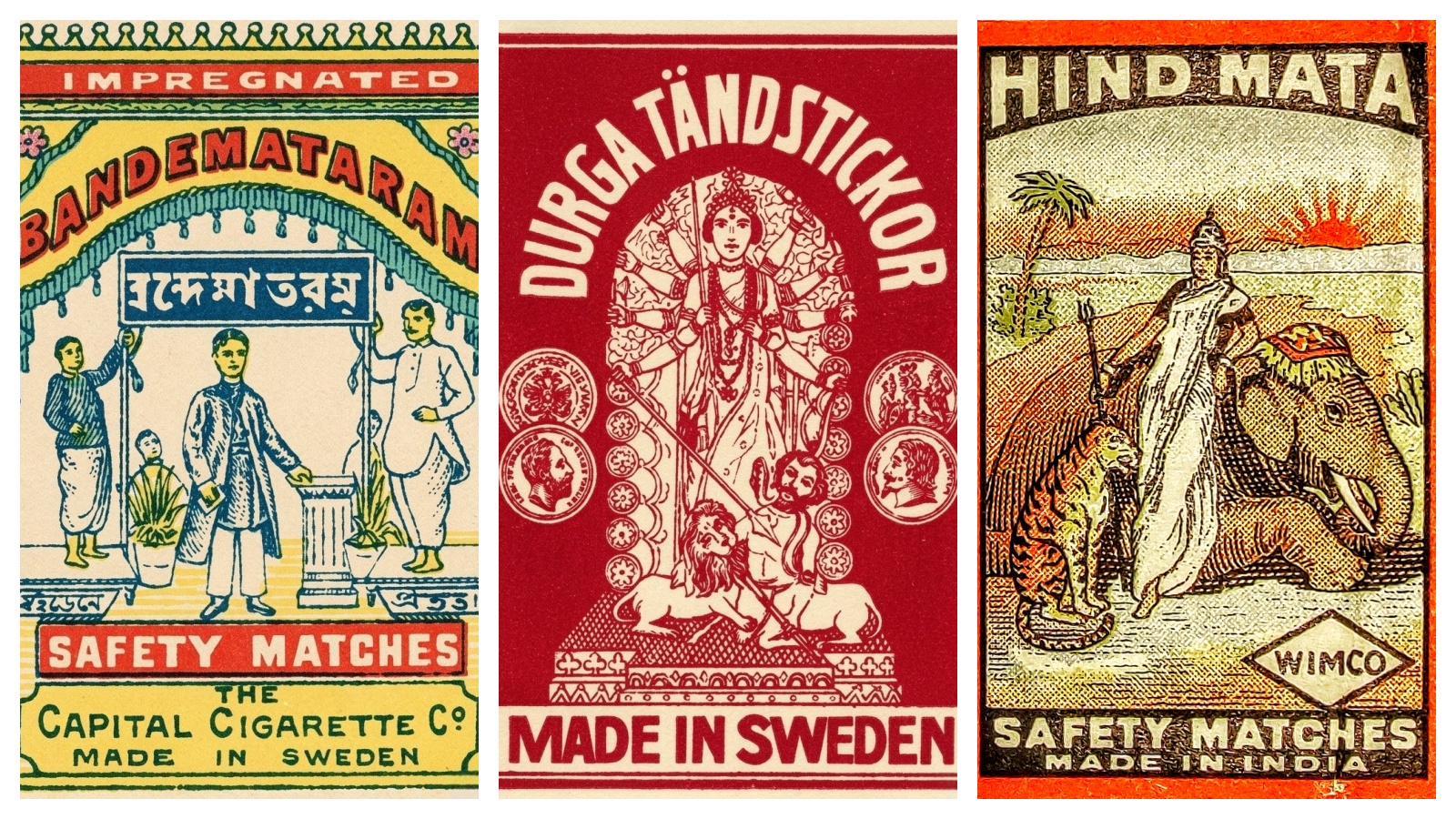 for Swedish Match, India was one of the most important markets, and labels on its matchboxes were part of the strategy. (Niladri Chatterjee, Jönköpings Matchstick Factory Museum and Vadstena National Archive, Sweden.)
This matters because Swadeshi was never merely a cultural mood. It was an argument about political economy, about who should own capital, who should control industry, and whose consumption counted as patriotic. As the economic historian Aashish Velkar writes in Swadeshi Capitalism In Colonial Bombay, by the 1930s, swadeshi had become a language through which capitalism and nationalism could reinforce one another, and by the 1950s, it had generated a sharper anti-globalisation rhetoric around Indian industry.
Against this backdrop, the foreign appropriation of nationalist imagery was not incidental. It was commercially intelligent and politically revealing.
It was also a form of appropriation. The same marketplace that encouraged boycott of foreign goods also created incentives for foreign companies to mimic indigeneity, borrow patriotic symbols, and present themselves as less objectionable than openly British competitors.
This ambiguity benefited Swedish firms. They could appear foreign but not colonially sovereign; European but not British; global but adaptable. That is why Swedish Match’s story matters. It shows how capitalism could inhabit an empire without ever being identical to imperial rule.
After empire
The British Empire eventually retreated, taking its viceroys and symbols of formal power with it. Swedish commercial power, however, proved far more resilient. WIMCO remained under Swedish Match Company’s control until 1991, and the Swedish group returned to a controlling position in the company in the late 1990s. The connection, therefore, outlived the empire by decades. Decolonisation, in this sense, did not dissolve foreign capital. It changed the terrain on which foreign capital operated. The longer history also intersects with postcolonial development.
In its article The Origins of Import Substituting Industrialization in India, historian Tirthankar Roy argues that India’s post-Independence import-substituting industrial regime had its roots in colonial protectionist debates of the 1920s, even though its application after independence became broader and less discriminatory. That continuity helps explain why firms such as WIMCO could survive in an altered form. They had already learned how to navigate tariffs, local production, Indian intermediaries, and the politics of nationality in the marketplace. It serves as a powerful reminder that while political flags may be lowered, the quiet, adaptable power of global capital often proves far more difficult to uproot than the empires that once sheltered it.
What, then, does this history change?
It reminds us that the British Raj in India was not a monolithic entity, and the economy of the British Empire was never a story of the Union Jack and the Indian tricolour, but a ‘polycolonial’ space where multiple global powers intersected, collaborated, and competed. It involved smaller European states, Japanese exporters, Indian merchants, provincial regulators, factory workers, and consumers whose choices were shaped by price, design, quality, and politics at once. It also shows that neutral or non-imperial actors were not outside colonialism. They could inhabit its opportunities without exercising direct sovereignty over it.
By placing Gandhi’s portrait, Bharat Mata’s image, or Vande Mataram on a matchbox, foreign manufacturers entered not only Indian markets but also Indian political imagination. That is why the history of Swedish Match in India is larger than the history of a company or a commodity. It is a history of how empire, nationalism, and capitalism became entangled in everyday life, and of how something as ordinary as a matchbox can illuminate the global complexity of India’s twentieth century.
*This article is based on research conducted at Linnaeus University Centre for Concurrences in Colonial and Postcolonial Studies and funded by the Swedish Research Council grant 2025-01142.
References:
da Silva Lopes, T., & Tomita, S. (2022). Trademarks as “global merchants of skill”: The dynamics of the Japanese match industry, 1860s–1930s. Business History Review, 96(3), 559–588.
Lindgren, H. (1979). Corporate growth: The Swedish match industry in its global setting. Stockholm: LiberFörlag.
Modig, H. (1979). Swedish match interests in British India during the interwar years (W. Barrett, Trans.). Stockholm: LiberFörlag.
Roy, T. (2017). The Origins of Import Substituting Industrialization in India. Economic History of Developing Regions, 32(1), 71–95.
Velkar, A. (2021). Swadeshi capitalism in colonial Bombay. The Historical Journal, 64(4), 1009–1034.
Eleonor Marcussen is senior lecturer at Department of Cultural Sciences, Linnaeus University in Sweden
Niladri Chatterjee is senior lecturer and researcher at Department of Cultural Sciences, Linnaeus University in Sweden