
Take a look at the essential concepts, terms, quotes, or phenomena every day and brush up your knowledge. Here’s your UPSC Current Affairs knowledge nugget on petroglyphs.
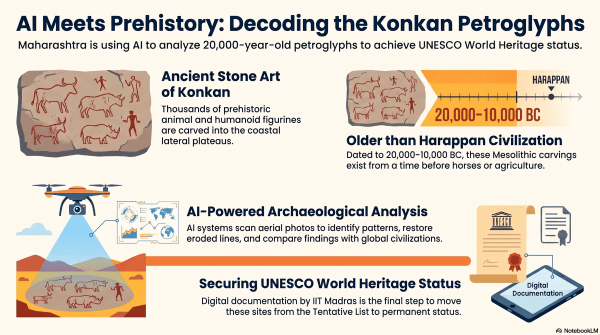
The Maharashtra government is making technology meet archaeology by using Artificial Intelligence (AI) to scientifically analyse, classify and interpret the origin and cultural etymology of thousands of prehistoric petroglyphs scattered across the Konkan region, a move that could significantly strengthen India’s bid to secure UNESCO World Heritage status for these ancient sites.
1. Petroglyphs are stone carvings of animal figures or humanoids, found in the lateral plateau regions across Ratnagiri and Sindhudurg districts of coastal Maharashtra. The carvings mainly comprise figurines, including turtles, elephants, peacock and rhinoceros. These were discovered throughout a series of expeditions and excavations carried out between 2017 and 2023.
2. According to archaeologists and experts, the origin of these carvings ranges between 20,000 BC and 10,000 BC and is older than the Harappan civilization whose earliest phase dates back to 7,000 BC-5,000 BC. The carvings have an average size of 50 square metres by 20 square metres.
3. In 2025, these structures were added to the temporary list of UNESCO World Heritage Sites in India. However, permanent status is yet to be granted. The state government has now appointed IIT Pravartak — the technology innovation hub of IIT Madras — for carrying out a digital assessment and documentation of these petroglyphs.
| A site must first be placed on India’s Tentative List, which is maintained by the Government of India and submitted to UNESCO — which requires the site to be on the Tentative List before it can be formally nominated. |
4. Tejas Garge, director at Directorate of Archaeology and Museums, Government of Maharashtra, said that among the carvings discovered, there was none depicting horse or bull.
 Infographics by NotebookLM
5. “The absence of horse figurines indicated that the carvings were created during the pre-historic era and the absence of bulls established that they were created during the pre-agricultural era. Therefore, it became clear to us that the origin of these carvings dates back to the Mesolithic era or the middle stone age period,” Garge added.
Story continues below this ad
| Bulls and horses are common in the pre-historic drawings and art forms in the Indian sub-continent where horses arrived between 1,500 and 1,000 BC, while agriculture was introduced around 9,000 BC. |
6. Speaking with The Indian Express, Shankar Raman, CEO of IITM Pravartak, the high resolution aerial photographs of petroglyphs will be scanned using an AI-powered system where the patterns will be identified, while filling missing lines and eroded portions.
7. The experts will then assess the figurines minutely to depict similarity with other petroglyphs found across the globe, like those from the Mesopotamian civilisation or any other civilisation that existed during that period. The tools used for making these carvings will also be identified along with the reasoning behind each figure that was drawn.
Nomenclature of the historic period
1. The study of the initial stage of human history is called Prehistory. It deals with the origins and growth of human societies before the advent of writing systems. This stage is succeeded by Proto-history. Protohistory is the period between prehistory and history and refers to the people who didn’t develop writing but were mentioned in the written records of a contemporary group.
2. In technical terms, human ‘history’ began with the advent of writing. Everything before that is ‘prehistory’, studied primarily using archaeological evidence (physical remains of the past), although ethnographic research (study of human cultures, communities) can also provide important insights.
Story continues below this ad
3. In the 19th century, Danish archaeologist Christian Jürgensen Thomsen came up with the first scientifically rigorous periodisation of human prehistory into Stone Age, then Bronze Age, and finally, Iron Age. Jürgensen’s basic chronology, based on our species’ technological advancement, has since risen to the status of dogma, although there have been significant refinements made to reflect diverse experiences across cultures.
4. The Stone Age began when hominids first picked up stone tools, some 3.4 million years ago (mya), in modern-day Ethiopia. This period, which went on till about 6,000-4,000 BP (Before Present), comprises 99% of human history. It is further divided into three periods — Palaeolithic (‘Old Stone Age’), Mesolithic (‘Middle Stone Age’, ), and Neolithic (New Stone Age).
5. The Palaeolithic period, which went on till about 11,650 BP in some places, is characterised by the use of rudimentary stone tools, and a hunter-gatherer lifestyle. The Mesolithc period is a transitional phase. The Neolithic period, which first began roughly 12,000 BP in West Asia, is characterised by the development of settled agriculture, and the domestication of animals.
BEYOND THE NUGGET: Rakhigarhi remains sent for scientific study
1. The Harappan civilization is believed to be one of the oldest world civilizations together with Egypt and Mesopotamia. It is identified as a Bronze Age civilization because many objects have been found that are made of copper-based alloys.
Story continues below this ad
2. Recently, the human skeletal remains excavated from the Harappan site of Rakhigarhi in Haryana was formally handed over by the Archaeological Survey of India (ASI) to the Anthropological Survey of India (AnSI), a national research institute under the Union Ministry of Culture, for scientific investigation.
3. Human remains have been increasingly studied using approaches from palaeoanthropological research (interdisciplinary study of human evolution), molecular biology, and DNA studies. These techniques have enabled researchers to investigate what ancient people may have looked like and to trace patterns of ancestry and migration.
4. Located in Haryana’s Hisar district, Rakhigarhi is widely recognised as one of the largest Harappan sites in India, spread across approximately 550 hectares. The site was occupied from the Early Harappan phase (circa 3300-2600 BCE) to the Mature Harappan phase (circa 2600-1900 BCE).
5. Archaeological excavations at the site have revealed evidence of a planned urban settlement including mud-brick fortifications, streets and drains. The site also boasts a well-developed craft tradition with the discovery of pottery, terracotta figurines, and uninscribed seals.
Story continues below this ad
Post Read Question
Which of the statements given below are correct about Petroglyphs:
(a) Piece of artwork painted or applied directly on a wall.
(b) India’s first Petroglyph Conservation Park will open at Alibaug in Maharashtra.
(c) Stone or rock carvings made by pecking directly on the surface.
Story continues below this ad
(d) Carbon dating process to identify the age of excavated human remains.
Answer Key
(c)
(Sources: Maharashtra bets on AI to solve Konkan’s oldest mystery, Was the Stone Age actually the Age of Wood?)
Subscribe to our UPSC newsletter. Stay updated with the latest UPSC articles by joining our Telegram channel – IndianExpress UPSC Hub, and follow us on Instagram and X.
🚨 Click Here to read the UPSC Essentials magazine for June 2026. Share your views and suggestions in the comment box or at manas.srivastava@indianexpress.com🚨