

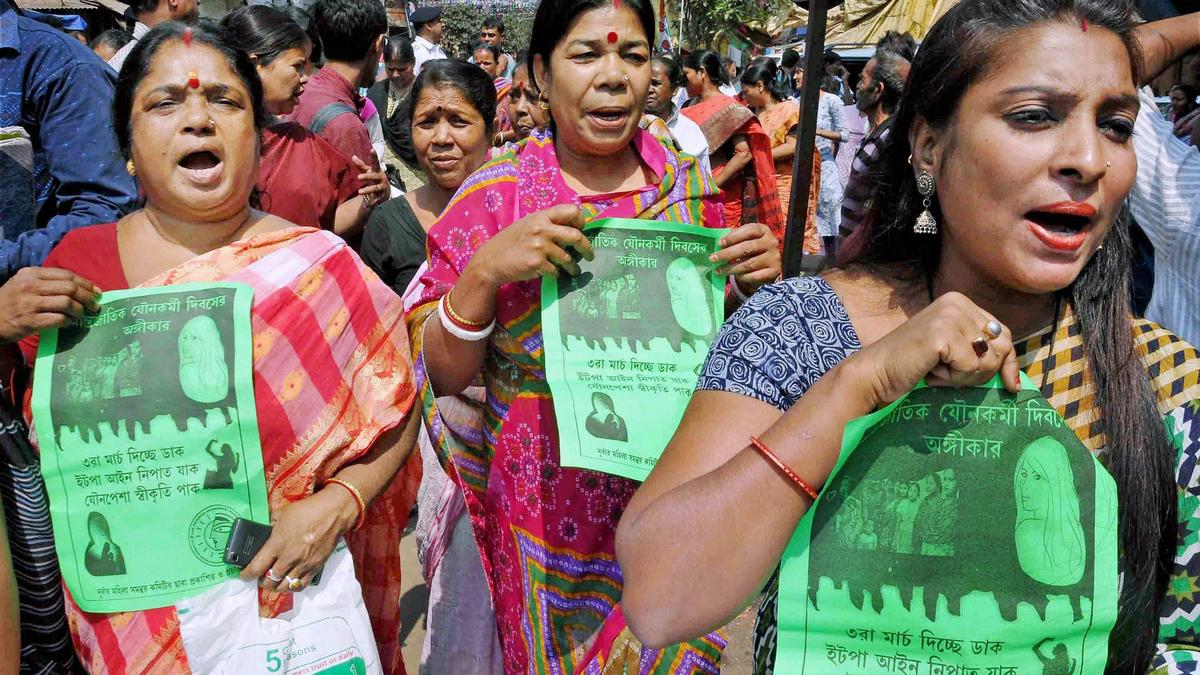

Sex workers participate in a rally on the occasion of International Sex Worker Rights Day at Sonagachi (India’s largest Red Light area), in Kolkata. File
| Photo Credit: PTI
DMSC lauded the court’s recognition of the rights and dignity of trafficking victims and those of voluntary adult sex workers
Durbar Mahila Samanway Committee, one of the largest sex workers’ collectives in the country, has hailed the recent judgement by the Supreme Court that consent of adult sex workers must be the primary consideration in decisions relating to rehabilitation.
DMSC, which has emerged from the Sonagachi Project, a community-led HIV intervention receiving international recognition for its success in reducing HIV transmission while promoting the collective empowerment of sex workers, emphasised that trafficking and consensual adult sex work are distinct realities.
Welcoming the judgment delivered by the Supreme Court of India on May 29 in Prajwala vs Union of India, DMSC said in a statement, “DMSC has long argued that conflating trafficking with sex work obscures the lived realities of both trafficked persons and adult women who voluntarily engage in sex work. Such conflation often leads to ineffective interventions, violations of rights, and misplaced policy responses. The Court’s recognition that the rights and dignity of trafficking victims and those of voluntary adult sex workers must both be protected is therefore a welcome and progressive development.”

“Drawing upon the principles articulated in the 2022 Budhadev Karmaskar judgment, in which DMSC was a party, the Supreme Court has acknowledged that while victims of trafficking have a right to protection and rehabilitation, such rehabilitation cannot be imposed through coercive rescue, detention, or institutionalisation of consenting adults,” the statement added. “The requirement that authorities undertake meaningful inquiries regarding age, consent, and individual circumstances before intervention is an important safeguard against arbitrary actions that have often caused further trauma and disruption in the lives of adult sex workers.”
A Bench of Justices J.B. Pardiwala and R. Mahadevan, while hearing a plea by the Senior Advocate Aparna Bhat for the preparation of a ‘Victim Protection Plan’, upheld the consent of the adult sex workers as the primary consideration for their rehabilitation.
Rejecting the paternalistic assumptions under Section 17 of the Immoral Traffic (Prevention) Act, 1956 (ITPA), the court also observed, “Such a one-size-fits-all approach fails to account for the diverse realities of those brought before magistrates. It is the victim’s life, liberty, and future that the order will determine, and thus it would be incongruous to hold that all of this can be decided without any regard for what the victim wants.”

The apex court said a threshold inquiry must be conducted by the magistrate when an adult person is produced before him under Section 17, to determine whether the individual is an adult and in the prostitution business voluntarily. The inquiry must also determine whether she is willing to be rehabilitated in protective custody.
“DMSC is particularly encouraged by the Victim Protection Plan outlined by the Court. Several of its principles resonate with the work of DMSC’s Self-Regulatory Boards, which have for many years sought to identify minors and trafficked persons, assess individual circumstances, and ensure that all decisions affecting their lives are guided by consent, dignity, and respect for agency,” the statement said.
The organisation said, “While we wholeheartedly welcome this pathbreaking judgment, we remain conscious that judicial recognition must be accompanied by effective implementation. We remain committed to working with governments, institutions, civil society organisations, and communities to advance responses that uphold rights, combat trafficking, and promote equality, dignity, and justice for all. The journey towards equality and recognition is far from complete.”
Published – June 30, 2026 11:31 am IST