

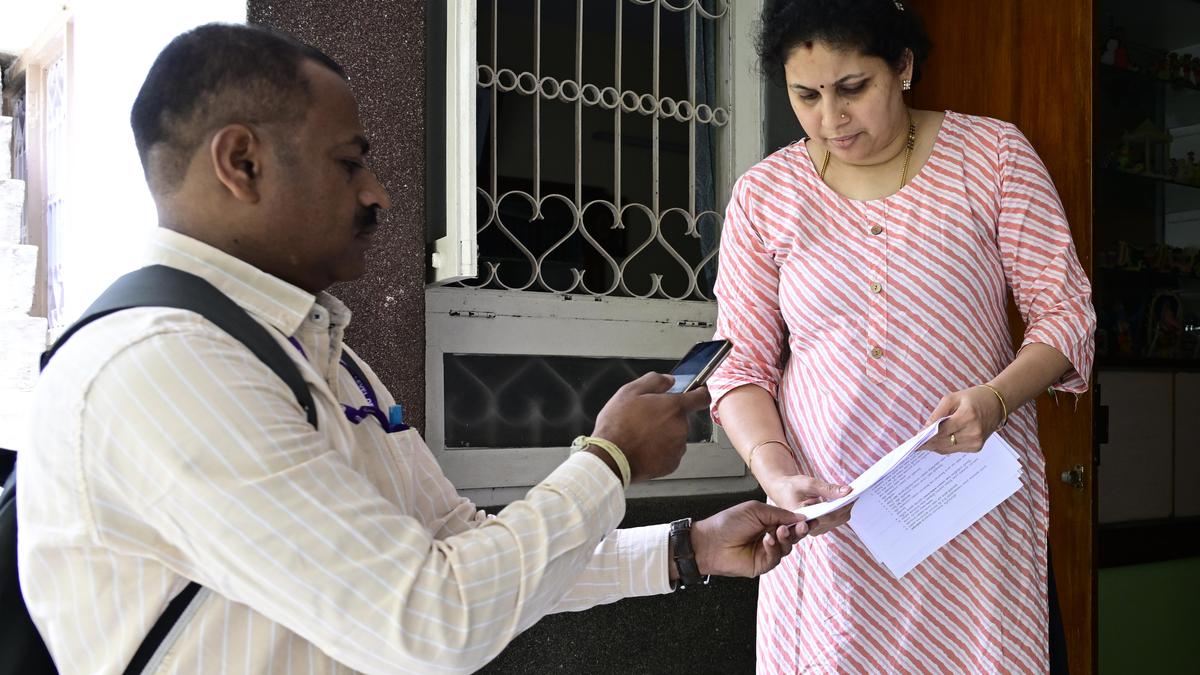
The door-to-door enumeration phase of Special Intensive Revision (SIR) of electoral rolls in Karnataka commenced on June 30, 2026.
Presented by the Election Commission of India (ECI) as an exercise to prepare a ‘pure’, ‘accurate’, and ‘inclusive’ electoral roll, SIR has become one of the most debated electoral exercises in recent years.
Electoral rolls are ordinarily updated through the routine Summary Revision process, where voters apply to enrol, correct details, change their address, or remove the names of deceased family members.

Along with the annual Summary Revision, the Election Commission has conducted Intensive Revisions, during which BLOs visit voters, verify the details furnished by them, and correct the electoral rolls. These exercises were generally conducted once every five or 10 years.
However, the SIR is different. Instead of relying primarily on applications from voters, now, Booth Level Officers (BLOs) will conduct door-to-door verification, distribute enumeration forms, collect them back, and verify the information before preparing a fresh draft electoral roll.
Here is everything you will need to know to navigate the enumeration process.
How to fill the enumeration form
The enumeration form will be partially pre-filled with details already available in the electoral roll.
Voters must first verify whether these pre-printed particulars such as their name, EPIC number, age, gender and address are correct. They then need to fill in the remaining fields, including their mobile number, place and date, and sign or affix a thumb impression.
The main part of the form is providing the details of the electoral roll in which the voter or an immediate family member (such as a parent) appeared during Karnataka’s last SIR in 2002.
The Election Commission has said electors can check these details through the Voters’ Service Portal if they do not remember them.
The Election Commission has said electors can check these details through the Voters’ Service Portal if they do not remember them.
Timeline of the SIR exercise
Highlights
- House-to-house enumeration: June 30 to July 29
- Draft electoral roll: August 5
- Last date for claims and objections: September 4
- Disposal of claims: October 3
- Final electoral roll: October 7
How and where to get more information on SIR
Electors can obtain assistance regarding the Special Intensive Revision at Voter Facilitation Centres (VFCs) and Booth Level Officer (BLO) facilitation centres functioning across Karnataka.
Services for voters include assistance in filling enumeration forms, details of the BLOs for each polling area, contact information of Electoral Registration Officers and other election officials, guidance on enrolment and correction of electoral roll entries.
Similarly, BLOs can use the BLO facilitation centres if there are network and other issues. Information is available at: https://ceo.karnataka.gov.in/vfc/details/
The office of the Chief Electoral Officer has also created an online repository containing Election Commission of India guidelines and circulars, frequently asked questions (FAQs), informative videos and booklets, presentations, training material and recordings of training sessions conducted for election officials and stakeholders.
The repository can be accessed at: https://drive.google.com/drive/folders/1vRput3HIGHsKVlINUpKJL34Xwbrk275-
In numbers
Total electors in Karnataka: 5,54,32,314
Total no. of Booth Level Officers: 59,050
No. of District Election Officers: 31
No. of Electoral Registration Officers: 224
No. Assistant Electoral Registration Officers: 336
No. of BLO Supervisors: 7,556
No. of Booth Level Agents: 1,15,112
What do the stickers mean?
During the house-to-house survey, Booth Level Officers (BLOs) will place colour-coded stickers on houses after their visit. A square violet sticker indicates that the enumeration form has been delivered to the household. A round red sticker indicates that the house was locked or no occupant was available when the BLO visited. BLOs will revisit such households, making up to three visits, wherever necessary, to distribute or collect the forms.
Published – June 30, 2026 06:23 pm IST