
The primary star cast of SS Rajamouli’s blockbuster Telugu action epic fantasy franchise Baahubali may have teased an upcoming threequel, but much before that would come Baahubali: The Eternal War, a two-part animated spin-off on Amarendra Baahubali, played by Prabhas in the live-action films. Last week, it was featured in the work-in-progress section at the Annecy Animation Film Festival, the most prestigious animation festival of the world, in France. In an exclusive interview with SCREEN, Baahubali: The Eternal War director Ishan Shukla discusses the genesis and scope of the project, Rajamouli’s involvement, and blending mythology with animation.
Baahubali: The Eternal War is in the work-in-progress section at Annecy Animation Film Festival. What is the work in progress at this point?

We’ve finished pre-production. We’ve been in production for the past six months, but animation takes a very long time. We’re aiming for a 2027 release.
Can you take us back to the genesis of this project?
Back in 2024, I was travelling to festivals with my film Schirkoa: In Lies We Trust. It was very well received and generated a bit of buzz. Sobhu Yarlagadda, head of Arka Media Works, who produced the Baahubali films, watched the film, reached out to me, and said we should do something together since the synergies are matching. At that time, he mentioned they were planning to take Baahubali into the animated space. That was also on my mind, to create an alternate Baahubali animated universe like Sony Pictures did with Spider-Man: Into the Spider-Verse. I thought about it for a long time, wrote a story, and pitched him the concept art about what happens to Amarendra Baahubali after his death. He liked the idea, took us to Rajamouli, and then it started developing there.
But how did you zero in on this idea of Amarendra Baahubali’s afterlife?
I’m a huge fan of Amar Chitra Katha, and have been reading it since forever. I thought if the story happens only on Earth or Bhu Loka, as we call it, I would get really grounded by the physicality of it. If you think of any of our scriptures, the spectrum is pretty wide. It’s not just about a single planet or star system, but covers multiple dimensions and galaxies. We’re so used to it that we don’t even think about whether there’s a Swarga Loka or a Pataal Lok. So, I wanted to take Amarendra Baahubali into a completely different realm altogether.
Story continues below this ad
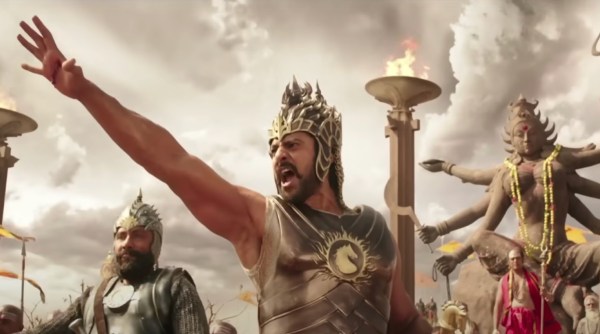 Prabhas as Amarendra Baahubali in Baahubali The Beginning.
Did you feel there was some unfinished business with Amarendra Baahubali’s arc in Baahubali: The Beginning?
I do think so. Although there’s a good payoff at the end (of Baahubali 2: The Conclusion) when his son avenges everything. But for me, he’s slightly more of a favourite for me than his son because of the choices he made and what he used to stand for. He stood by his mother even when she was doing something wrong. I think it was like the Rama character, too pure. When something tragic happens to this person, you feel that there should’ve been more. We’re primarily trying to explore what he’s thinking now that he’s dead and what are the choices he’s going to make now in the afterlife.
Does he know the answer to the question that haunted us for a year: why did Katappa kill Baahubali?
No, and that’s the most tragic. Philosophically speaking, it’s tragic because Amarendra Baahubali would never know what he would’ve been had he not been killed. There are so many stories of Medieval India where these people die when they’re supposed to become kings, and they never even get to know why. That limited information is even tragic.
Story continues below this ad
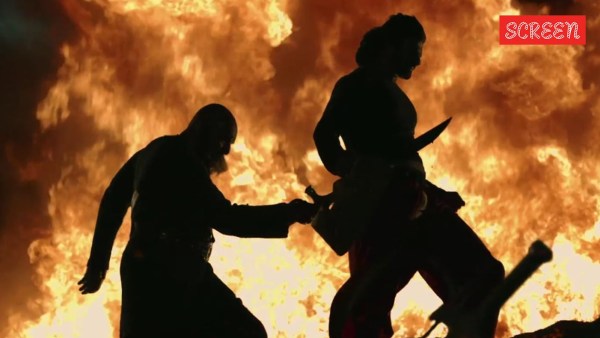 Baahubali: The Beginning ended with Katappa killing Amarendra Baahubali.
Did Rajamouli also feel Amarendra Baahubali deserved more screentime?
He didn’t mention that specifically, but what he really liked that the expansion is very natural. It doesn’t feel forced because when he dies, obviously, he’s going into going into some loka. And I got to know he also loves Amar Chitra Katha, anime, and gaming. I thought there would be a gap, but we could brainstorm very freely. It was so much fun! The coolest thing was he makes you locate the core issue around which everything will go around. He also suggested that since the scope is very big, it’d be better to break it into movies. Then we decided what would be the breaking up point. It was very encouraging for me.
So, are you working on part 2 simultaneously?
Yes, it’s basically one big story split into two films. We’re not working on the production of part 2 yet, but yes, some pre-production work is going on simultaneously.
Since Rajamouli is primarily busy with Varanasi, how involved has he been in this project? Because while you’re an expert in animation, he’s the master of scale. How much is he contributing on that front?
Story continues below this ad
I’ve done Star Wars: Visions before this. So, that gave him the confidence that I can handle this. But this is too big. What’s great about Rajamouli sir and Sobhu is that they check on you only during the milestones. So, they read the script, gave it a go ahead, and provided suggestions. He’s very busy with Varanasi right now, so the last proper meeting we had was last year. Basically, his primary sign-off is on the script. We’re free to do our own thing, but we just do these quarterly check-ins. Right now, he’s super busy, so that’s not possible as frequently.
How important was to have the original voices of Prabhas as Amarendra Baahubali and Ramya Krishnan as Sivagami in animation?
It’s actually important to have them. It’s primarily Sivagami’s story. So as soon as you hear a different voice, it becomes jarring for the fans. They’re used to that persona and voice. In animation, the voices drive everything. We record the voices first and then create the performances. Prabhas loves the idea and the visuals, and he’s contributing his voice even in other languages.
So, Sharad Kelkar wouldn’t dub for Prabhas in Hindi this time?
Yes, that’s the plan.
Story continues below this ad
Do you think this blend of mythology and animation will emerge as India’s USP in the global animation market?
I’m very optimistic about it. As a filmmaker, I do feel that if you want to tell something larger than life, animation is the perfect medium. We’re at a conversion point, where things are working for India in animation. We’ve gained momentum in the past two-three years. We had such conversion points in the past as well, but they didn’t materialize into anything bigger. We just ended up becoming a service industry. Now, I feel the next five years are going to be a game-changer. I’m saying this based on the reception for the teaser. There were people not form India, who didn’t even know it’s an Indian movie, getting curious to know more about devas and asuras. Someone asked me what’s the dance Baahubali is doing, and I told them it’s tandav.
Now that a two-part live-action adaptation of the Ramayana is in the works, it’s being compared to Yugo Sako’s 1993 anime adaptation, Ramayana: The Legend of Prince Rama, since it’s considered the gold standard till date. Do you think animation has an edge over live action when it comes to mythology?
That’s precisely what I’m saying. There are some stories which can be told only in animation. If you try to realise them in live action, they start to look weird and gimmicky, especially when it comes to gods. We’re used to imagining them or seeing their paintings. As soon as you put a face to them, we can’t relate to them. There are a lot of things that can happen. Ramayana and Mahabharata adaptations can co-exist in both live action and animation. It’s nice because then more people would get to know about them. I know people who can’t watch too much animation or too much live action. So, it’s also about who we’re making it for. I’m making it for myself. I enjoy this kind of animation, and slowly, people are also enjoying it.
Story continues below this ad
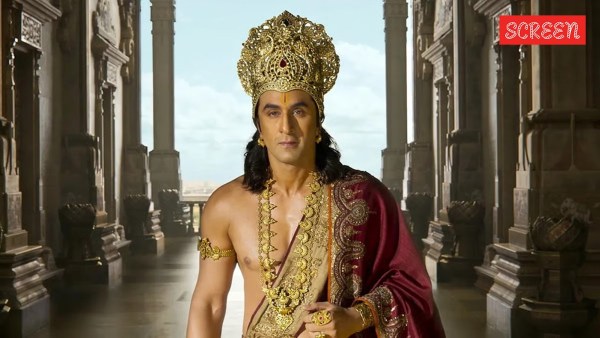 Ranbir Kapoor as Rama in the live-action adaptation of the Ramayana.
What do you think has caused this shift towards animation in India?
During Covid, a lot of people began watching a lot of anime. Not that they weren’t before that, but almost every person I know was watching some anime or other. A lot of them started playing video games because they couldn’t go out. So, once they got exposed to it, there was a thirst for local storytelling. Pre-Covid, if you had any Indian animation project, people weren’t used to watching it. It was a bit jarring for them.
Baahubali set such high standards that the Netflix India prequel series on Sivagami was cancelled even after it was shot. Do you feel the pressure of taking on the legacy of Baahubali?
There’s definitely pressure from fans. I really want to make sure we get it right. I’ve actually moved from Delhi to Hyderabad with my family because it’s a long gestation period. I know the love for Baahubali so much that I sense it all the time. But once the teaser was released, the pressure was eased. The film is very stylized in the way it looks, and the idea of afterlife is very out there. There was definitely some skepticism about whether people would take it, but now that they’ve accepted it, I feel a little less stressed.
Story continues below this ad
What are some animated movies that have influenced the style of Baahubali: The Eternal War?
There are too many North Stars to name, actually. The animation style is the painterly CGI animation, which has become mainstream in the past six years. From sweet-looking, photorealistic Disney Pixar films, we see a little more of a hand-painted touch to the movies. It started with video games in 2010-11, and then moved to films. When Spider-Verse came out, it showed the world animation can look like concept art. Dishonored (2012), a video game which came out a long time ago, and Arcane (2021, Netflix) were also interpretations of the same style. Animation style has become more artist-driven now instead of everyone wrapping it in photorealistic, plastic-y forms, which is very refreshing and liberating.
Also Read — Salman Khan to leave Galaxy after 52 years, gets approval for new 6-storey home: report
Finally, how much Artificial Intelligence are you using in this project?
Story continues below this ad
I dabble a little in AI because I feel it’s going to become very big in the near future. It’s intoxicating a lot of things, but I feel once you start feeding it your own creative style, it does better, but still not up to the mark. So, my use of AI is limited to the very early stages of pre-production, when there are no artists attached, to inform my writing. Using it in production is still a few years away. I’m an artist myself, so I want every step of the process to be touched by an artist, unless AI has a very good backpacking. It makes a mundane part of my filmmaking easier, which is more about the backend and not what artists are touching.