

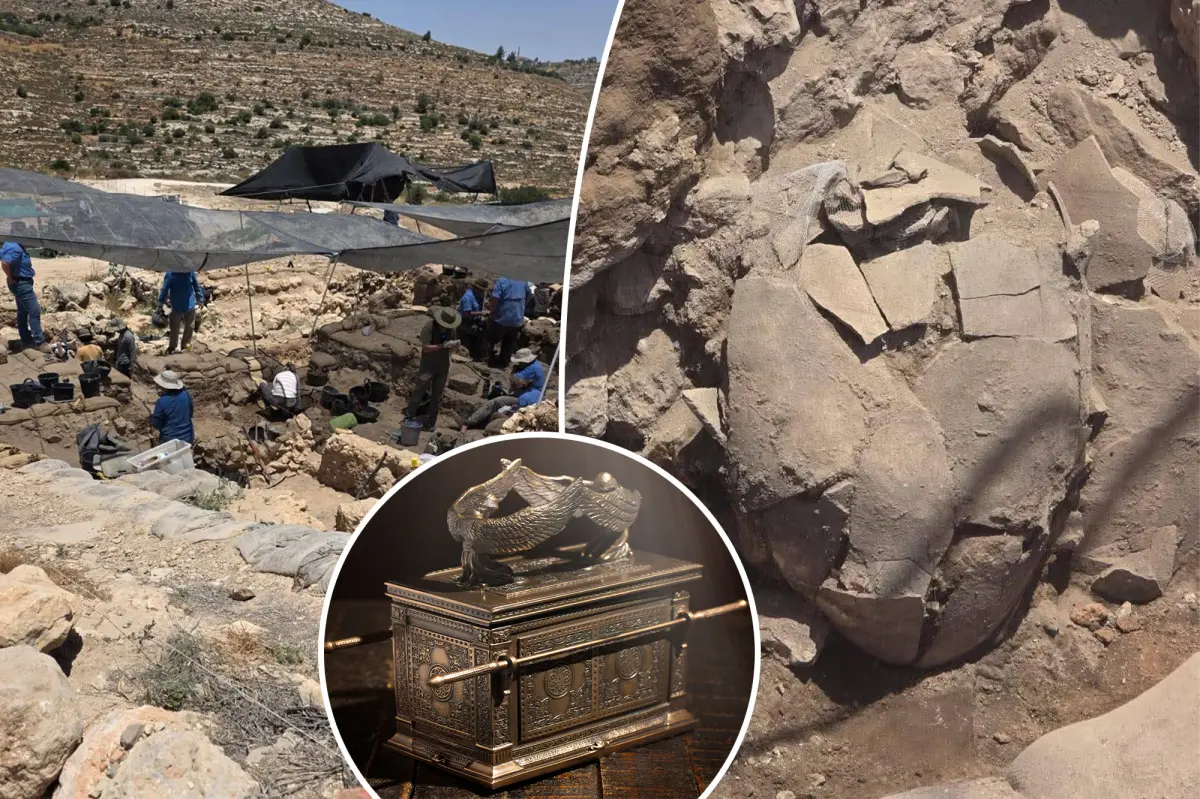

It’s the kind of discovery that sounds more Indiana Jones than archaeology lab.
Researchers digging in Israel say they may have uncovered ruins linked to the Ark of the Covenant — the gold-covered biblical chest said to have held the Ten Commandments.
The Ark is described in scripture as a sacred chest built by the Israelites after their Exodus from Egypt. It was kept in the Tabernacle, a portable sanctuary some scholars date to around 1445 BC.
According to the Bible, Moses himself placed the stone tablets inside.
And then — like a divine disappearing act — it vanishes from the biblical record before the Babylonian destruction of Jerusalem in 586 BC.
Now, archaeologists with Associates for Biblical Research (ABR) say they may have found new clues at biblical Shiloh, an ancient site in the West Bank linked to early Israelite worship.
Shiloh is described in scripture as the place where the Tabernacle stood for more than 300 years, making it one of the most important religious centers in early biblical history.
And this season, the dig has turned up something big.
Researchers say they’ve uncovered additional walls from a massive structure that may be part of the Tabernacle complex, along with worship-related artifacts and newly identified fortifications that could help piece together the ancient city’s layout.
The team’s biggest breakthrough came with the discovery of a southern wall — a key piece that helps define the structure’s full footprint.
The building runs east to west and seems to match the size and layout described in the Bible for the Tabernacle — the portable sanctuary said to have been built after the Israelites left Egypt.
In 2025, the ABR team said they had already found a large Iron Age structure that seemed to match the Bible’s description of the Tabernacle. The new findings don’t prove that — but they do make the case a bit stronger.
Dr. Scott Stripling, director of the Tel Shiloh excavation, said the new evidence is helping researchers better understand what they’re looking at.
In a blog post on the Bible Archaeology Report, Stripling said that the discovery of the southern wall “now enables our researchers to reconstruct the full dimensions of the building and better evaluate its function and significance.”
And it’s not just walls that are fueling excitement.
Archaeologists have also uncovered a trove of ritual-related objects near the structure, including ceramic pomegranates, altar horns and murex shells.
The last of the above three is especially intriguing, since the shells were used to produce the blue dye associated with priestly garments described in the Bible.
Many came from the right side of the animal bodies — a detail researchers say echoes Leviticus 7, which assigns the right side for sacred and sacrificial offerings.
This year’s excavation also uncovered more of the city’s defenses, including a gate system and several rooms that give researchers a better idea of how the city was built and protected.
Researchers believe the discovery could relate to the same gate complex referenced in the biblical account of Eli’s death, though that interpretation remains tentative.
“These discoveries provide an important window into the earliest occupational phases of Shiloh and help us better understand the site’s history before the Israelite settlement,” Stripling said.
Despite the buzz, researchers caution that no Ark of the Covenant has been found — and there is still no definitive proof that the structure is the biblical Tabernacle.
But archaeology in the region has been turning up surprises on all scales — as previously reported by The Post.
While on a family outing to Tel Azekah last year, 3-year-old Ziv Nitzan stumbled upon a 3,800-year-old scarab amulet as she walked along a trail with her family.
Daphna Ben-Tor, a specialist in ancient amulets and seals, later confirmed it was a Canaanite scarab from the Middle Bronze Age.
Tel Azekah, where the toddler found the dung beetle-shaped artifact, is a well-known archaeological site in Israel’s Shephelah region that has been under excavation for more than a decade.